[et_pb_section bb_built="1" fullwidth="off" specialty="off" _builder_version="3.0.89" background_image="https://coeli.com/wp-content/uploads//2018/08/malmo-bro-comp.jpg" parallax="on" module_class="gen-trustee-single-hero"][et_pb_row][et_pb_column type="4_4"][/et_pb_column][/et_pb_row][/et_pb_section][et_pb_section bb_built="1" fullwidth="off" specialty="off" _builder_version="3.0.89" custom_padding="0px||0px|"][et_pb_row][et_pb_column type="4_4"][/et_pb_column][/et_pb_row][et_pb_row _builder_version="3.0.89" background_position="top_left" background_repeat="repeat" background_size="initial" custom_padding="0px|||" custom_padding_phone="23px|||" custom_padding_last_edited="on|tablet" module_class_2="gen-trustee-single-sidebar" module_class="gen-single-news-content-row "][et_pb_column type="4_4"][et_pb_text admin_label="Tillbaka-knapp" _builder_version="3.0.89" background_layout="light" border_style="solid" custom_margin_tablet="||17px|" custom_margin_last_edited="on|desktop" module_class="gen-back-button hide-in-print" border_style_all="solid"]
Note that the information below describes the share class (I SEK), which is a share class reserved for institutional investors. Investments in other share classes generally have other conditions regarding, among other things, fees, which affects the share class' return. The information below regarding returns therefore differs from the returns in other share classes.
Before making any final investment decisions, please read the prospectus, its Annual Report, and the KIID of the relevant Sub-Fund here
[/et_pb_text][et_pb_text admin_label="Tillbaka-knapp" _builder_version="3.0.89" background_layout="light" border_style="solid" custom_margin_tablet="||17px|" custom_margin_last_edited="on|desktop" module_class="gen-back-button hide-in-print" border_style_all="solid"]
This material is marketing communication
[/et_pb_text][et_pb_text admin_label="Datum / Skriv ut" _builder_version="3.0.89" background_layout="light" border_style="solid" custom_margin_tablet="||17px|" custom_margin_last_edited="on|desktop" module_class="gen-single-news-date-module gen-trustee-print-module hide-in-print" locked="on" border_style_all="solid"]
[blog_post_date]
Print
[/et_pb_text][et_pb_text _builder_version="3.0.89" background_layout="light"]
Monthly Newsletter Coeli Absolute European Equity – September 2022
SEPTEMBER PERFORMANCE
The fund’s value decreased by 7.5% in September (share class I SEK). The Stoxx600 (broad European index) decrease during the same period by 6.6% and HedgeNordic’s NHX Equities declined preliminary by 2.8%. The corresponding figures for 2022 are a decrease of 31.6% for the fund, -20.5% for the Stoxx600 and -7.6% for NHX Equities.


EQUITY MARKETS / MACRO ENVIRONMENT
This is the 57th monthly newsletter since our inception in January 2018 and the feeling is that there has been an exceptional number of big events in recent weeks. If we try really hard, we can see some glimmers of light in the form of a continued surprisingly strong economy, but otherwise the month brought mostly negative news. The uncertainty here and now is still high. From a positive angle and at the risk of being provocative there are now significant opportunities for the persistent and careful long-term investor. With each passing month we are getting closer to the tipping point. When the turn comes, as in the spring of 2003 and 2009, it usually happens quickly.
Bullets points outlining some of the events:
• Continued higher inflation data from the US and most of the Eurozone.
• A number of the world's central banks raised their respective key interest rates. Our tone-deaf Riksbank raised the most with a quadruple increase of 100 basis points.
• In practice, we now also have a currency war with the USD (so far) leading by far.
• The UK's new Prime Minister Liz Truss begins with record-breaking and unfunded tax cuts that make the development of the British pound look like a flash crash.
• The IMF (!) comes a few days later with an unusual warning to the UK government.
• The Bank of England came to the rescue, as the UK's pension system effectively received margin calls when interest rates rose sharply.
• After a month as Prime Minister, more than half of the UK population wants Liz Truss to resign. We, who thought it couldn't get any worse than with Boris Johnson.
• Putin annexes parts of eastern Ukraine and thereby raises the tone considerably.
• Nord Stream explodes underwater off the shores of Bornholm and the beaches of Österlen and sabotage is likely.
• Vague rumors that President Xi would be under house arrest. China's National Congress is on the the 16th of October, when Xi will be elected for a third time as leader.
• Italy held elections and it was a clear victory for the right-wing nationalists.
• Some profit warnings have started to appear, for example from consumer companies such as Thule and Nike.
• Queen Elizabeth II dies on September 8. Rest in peace.
The world's stock markets started the month with a slight positive trend, but on September 13, US inflation data came out and that changed the conditions. Instead of an expected improvement, there was a further acceleration in inflation which directly put pressure on the stock markets. The S&P500 fell in September by 9.3%, the Nasdaq by 10.6%, the SXXP600 by 6.6%, the Stockholm broad index by 7.4% and the SEB small cap index by 10.5%. The fund's value fell by 7.5% percent. More on that in the summary.
US Federal Reserve Chairman, Jerome Powell, raised interest rates in line with expectations, by 75 basis points at the end of September. It was the third triple increase in a row and in the press conference afterwards he was hawkish. "I wish there were a - a painless way to do that. There isn't. So what we need to do is get rates up to a - to the point where we're... putting meaningful downward pressure on inflation, and that's what we're - that's what we're doing."
We are now only a few increases from the highest level according to the FED's own forecast. On the last day of the month, differences of tone emerged for the first time from the various FED members where some of them began to speak a little more softly, that perhaps they should not maintain such a high speed in interest rate increases. We will not be surprised if the last increase comes this year, that is, earlier than the Fed's forecast.
Below, consumer satisfaction in the eurozone coincided with unemployment. Here there is a clear lag in all economic data and it looks like unemployment will soon shoot upwards.
 Source: Themarketear.com
What actually happened in Britain? It started with the Bank of England raising its key interest rate by 50 basis points against the expected 65. This, despite the fact that inflation is running at around 10% and that the pound is the Western world's worst currency this year (the Swedish krona takes a dishonourable second place). The following day, the much-talked-about mini-budget came with extensive unfunded tax cuts, mainly for the wealth. Unfunded means that the supply of bonds will rise when funding is needed. The image below shows the drama for the pound over the past week. The decline came in 41st place measured over 160 years and 47,000 trading days!
 Source: Bloomberg
After falling about 5% against the USD, most of the decline was recovered a week later. We guess that it is due to the market assessing the likelihood that the proposal will be withdrawn or that Liz Fross and/or Finance Minister Kwarteng will resign shortly. British tabloids are busy.
Late addition: on Monday 3rd of October, after this document was sent for editing, the UK Treasury apparently made a humiliating u-turn as they likely withdraw their tax proposal. Embarrassing to say the least, but very good. Interest rates are falling on a broad scale around the world in a form of relief rally.
 Source: Daily Star
At the same time, the interest rate on Great Britain's government bonds rose sharply. Around the turn of the year, the interest rate on the 30-year-old was 1%. When the new proposal was announced, the corresponding interest rate reached 5% and a week later is around 3.8%.
 Source: Bloomberg
Had the Bank of England not stepped in and bailed out more than £70 billion worth of bonds, large parts of Britain's pension capital would likely have come under a lot of pressure. When interest rates rise, the value of the bonds falls.
So we have gone from an extremely expansionary monetary policy that created an inflationary crisis, to a very strong and rapid tightening that is now creating a global economic crisis. That in turn prompts Britain's new government to launch an unfunded demand-stimulating tax package, which in turn prompts the Bank of England to make an emergency declaration not to topple the pension funds and support bond purchases while raising interest rates. It feels like a stubborn circular reference in an Excel sheet, but on a slightly larger scale.
Only since the financial crisis has the pound fallen from two dollars to just over one dollar. When King George V ruled, five dollars were paid for a pound. That says something about Europe's structural problems and challenges.

The Swedish krona is also (once again) in the running. It is only a little over six months since the Riksbank announced that the key interest rate would be kept unchanged until the second half of 2024. Most people in the financial market were very surprised given what was clearly visible at the time in the form of inflation. In September, the interest rate was raised by a whopping 100 basis points, which was shockingly unexpected. Despite that, the Swedish krona weakened further, probably when investors judged that it was too much and too fast, which of course damages the economy more than necessary. A weaker krona contributes to high inflation. Below, the Swedish krona against the US dollar, which has moved from 8.50 to just over 11 kronor in less than a year. The krona has never been weaker against the US dollar.
 Source: Bloomberg
Our overall view is simply put that the world's central banks are trying to compensate for their grave mistakes by now acting forcefully and showing great action. It feels like a law of nature that they will make a double fault, which will be costly. Raising interest rates is absolutely right, but they are doing it far too aggressively, basing their decisions by studying economic data that has a lag of several months with an increased risk of recession.

We recommend watching the interview below with Jeremy Siegel, a well-known professor of finance at the Wharton School of the University of Pennsylvania.
Watch the interview.
Turkey, with 80% inflation, is doing the opposite of everyone else and cut interest rates in September. Wonder what they were thinking? Fascinating.
 Source: Goldman Sachs
China continues with its astonishing Covid strategy with hard lockdowns, which has clear negative effects on the economy. From 1982-2012, China had an average annual growth rate of 10.3%. After that, growth has been 6.2%. This year, growth is expected to be a modest 3.0%. If you look at it from the bright side, oil prices would have been significantly higher if they were at a normal growth rate. Presumably, they need to stop the insanity of their Covid strategy soon, which, all things being equal, will contribute positively to global growth.
 Source: Goldman Sachs
 Source: KluddNiklas
A volatile market can lead to some frustration. We lighten up the mood a bit and offer a conversation between a slightly frustrated customer and its broker. Turn it up!
Frustrated with the Market part 1 and 2:
https://twitter.com/PriapusIQ/status/1572930760939651072
Long positionsBonesupport
For some time, we have built up a position in the medical technology company Bonesupport which is headquarted in Lund in the south of Sweden. The company develops and sells the product Cerament, which comes in three product forms: BVF, G and V. Cerament is a so-called bone graft substitute that is injected into the bone in case of bone damage. After twelve months, the damage is completely replaced with the body's own bones. Cerament G & V contains antibiotics and has only been available on the European market. During May, the company received market approval for Cerament G for the treatment of bone infections in the USA. CEO, Emil Billbäck, describes this as "the most important milestone in the company's commercial history to date".
Bonesupport has a well-thought-out and elegant business model, which is quite unusual for a company in such an early commercial phase. During the last three years (Q2 19 to Q2 22), the company has grown on average by 34% per year while being heavily affected by the pandemic, quite a feat.
It can always be a bit difficult to bet on a new product launch, but we have noted some driving forces that make us feel confident in Bonesupport:
• Already established in the USA with sales there of Cerament BVF since 2018. Current turnover of approximately SEK 150 million annually in the USA. (In Europe, sales of Cerament G are roughly 6.5x greater than Cerament BVF.)
• Cerament G is a better product than the existing Cerament BVF.
• In the USA, there is a lack of a clear "standard of care" for the treatment of bone infections. Today's methods are sold off-label. Now Cerament G will be sold "on-label".
• Cerament G provides health economic benefits. Cerament G is a one-step operation, compared to today's treatment that requires double operations and all the complications that entails. The compensation system in the USA is greatly reduced for repeated visits for the same ailment - there is an incentive to make the patient healthy at the first treatment. Here, the clinical studies show that Cerament G is far, far better than existing treatment methods.
• Sellers have strong incentives to sell Cerament G over existing Cerament BVF, as they retain 30% of the sales price as commission. We estimate that the price is about double, so a seller makes twice as much on the newer product. In addition, Cerament G is likely to be one of the most profitable products in a seller's product catalogue.
• The company was awarded NTAP (new technology additional pay), an extra compensation to cover the extra cost arising from the use of Cerament G. It is worth noting that only about 10 products have been awarded NTAP out of several hundred applications this year.
We believe that Bonesupport is at the infancy of becoming a true quality company. We see several indications of this already. The company is building a platform from Cerament, so in the long run Bonesupport will not be a single product company. In addition, the company has good opportunities to become the "standard of care" for the treatment of certain skeletal injuries. There is a lot of clinical data that backs up the product's properties and the data is always presented through reputable scientific publications. Now the company has several growth legs to stand on, geographically, increased penetration with existing customers, new customers and new products as well as more indications. We think the market underestimates the opportunity that opens up in the US but also the duration of the business. The company can grow quickly for a long time with the possibility of reinvesting its capital at a high return.
Pets at Home
After we divested Musti (which we wrote about last month), we have replaced the company with British Pets at Home. Pets at Home has a strong position in the pet trade in England. Unlike Musti, the stores are larger, and they often also house a veterinary department. The veterinary and store operations create significant sales synergies because they complement each other and generate more traffic to the respective store.
Our view is that Pets at Home is an even better company than Musti, and also at a lower valuation. Pets at Home shares have fallen along with many other UK consumer companies (and the UK market in general). However, the pet industry is very resilient in times of consumer financial concern, and we believe that Pets at Home has been severely punished after the series of bad news that impacted all of our wallets.
We were a tad too quick to buy the share, which contributed negatively in September. We hope and believe that we will recover the losses as the company's financial updates come in.
Tate and Lyle
Tate and Lyle shares had a weak month following positive attribution earlier in the year. There are no obvious reasons for the decline, other than the stock performing better than many others this year, which surely made profit-taking palatable for some. On top of this, Tate and Lyle is listed on the London Stock Exchange, which famously had a turbulent September (for reasons detailed in our first section). Some are also worried about increased raw material and energy costs, but we believe that Tate & Lyle has good coverage for this via price increases. In addition, the company benefits greatly from its dollar exposure.
Short positions
The short portfolio contributed significally to a positive result during the month. The biggest positive contribution was made by our short positions in a Swedish small company index and in the German DAX. Several share-specific short positions made positive contributions to the result. Some of the names were Danish Vestas, Swedish Mips, German Puma and Finnish Qt Group.
Exposure
The net exposure, adjusted for our unlisted holdings, at the beginning and end of the month was 52% and 53% respectively.
Summary
In just over 10 weeks it's Christmas, but first we'll experience one of the most interesting reporting seasons in a long time. Some companies are still largely unaffected by what happened during the year, while others work under radically different conditions than when they entered 2022. Forecasting comments will determine much of the price reaction.
Inflation data in recent weeks has not yet given the market any fuel to lift share prices. Our clear impression when we talk to companies and other sources is that the economy has lost momentum after the summer, which is also what the central banks want to curb inflation.
What is still missing, but will probably come in force this reporting season, is for analysts to start adjusting down their earnings estimates, as they are way too high. The delicate question is how much is priced in already?

The other delicate question is: How much should the profits be adjusted? The table below shows that the average decline in profits when there has been a recession since 1990 has been 29%. The financial crisis stands out with 50% in profit decline.

Should we end up around the historical average this time around, Europe would trade at 13-14x earnings in 2023e, roughly matching the historical average valuation. Our conclusion is that with today's conditions, there is a lot of misery included in the stock prices.

Another indicator that shows the Philly Fed (index that measures changes in the business climate) correlated with S&P500 earnings per share. Estimates are too high in the US as well.

In the United States, valuations have in percentage terms decreased less than in Europe and Great Britain, where there has been a substantial multiple contraction.

The UK is trading around 8x earnings! Admittedly, there are more low-valued oil stocks there than in the rest of Europe, but these are very low levels. It is also one of the reasons we have 35% net exposure to British companies.
 Source: themarketear.com
Rising inflation has a negative impact on company valuations and vice versa. Our view remains that we are around the highs for inflation (in the US).
Higher inflation has in the past been consistent with lower valuations: 
Inflation drives up interest rates, which in turn puts pressure on values. We are not there yet, but there will be a time when it goes the other way.

The record low European valuations are the reason why, for example, Kepler Cheuvreux last week upgraded European shares from underweight to neutral. However, they are still underweight stocks even if they are starting to get ready to increase the risk in the coming months.


The VIX, volatility index, has risen recently along with other indicators such as the put/call index. There have been very large purchases of put options in the market which indicates a certain panic to protect against further market declines. It is usually a strong contraindication.

Our conclusion is that the likelihood of the US and Europe entering a recession has increased over the past month. The central banks are raising rates too aggressively and they are trying with all their might to make up for their mistakes from earlier this year. However, if the economy were to enter a recession we believe that the conditions for it to be a mild one are relatively good, as there are many positive indicators. For example, sharply falling shipping rates and raw materials, that both households and companies have a good economy and that China should soon be able to start up after almost three years of Covid chaos. For Europe, the big problem continues to be energy.
Our view since May, that we have a range-bound market is being tested right now as we are just below previous lows on several stock indices. Catalysts that can spark a rebound are an extremely defensive positioning of investors, that most investors are negative and that the stock markets are in most cases now well oversold. In addition, October is in the vast majority of cases a positive month on the stock market (which is far from a guarantee that it will be repeated this year).
 Source: themarketear.com
In the end, it boils down to the long-term market reversing only when the FED turns up and we believe that the last rate hike is now close. Inflation should soon slow down, interest rates will then follow downwards as well as the US dollar which is currently plaguing US exporting companies. We believe that inflation will be significantly lower in 12 months from where we are today. The string is taut and it won’t take much for the market to shoot upwards.
Mikael & Team
Malmö on 7th of October 2022
[/et_pb_text][et_pb_post_title _builder_version="3.0.89" title="on" meta="off" author="off" date="off" categories="off" comments="off" featured_image="off" featured_placement="below" text_color="dark" text_background="off" border_style="solid" module_class="gen-single-news-heading-module gen-trustee-single-headline" date_format="d M, Y" border_style_all="solid" disabled_on="on|on|on" disabled="on" /][et_pb_text admin_label="Coeli Nordic Corporate Bond Fund R-SEK" _builder_version="3.0.89" background_layout="light" module_class="gen-table-module" disabled_on="on|on|on" disabled="on"]
Coeli Nordic Corporate Bond Fund
| Performance in Share Class Currency | 1 Mth | YTD | 3 yrs | Since incep |
| Coeli Nordic Corporate Bond Fund - R SEK | 1.30% | -0.93% | 3.38% | 14.52% |
| | | | |
[/et_pb_text][et_pb_text admin_label="Coeli Nordic Corporate Bond Fund R-SEK" _builder_version="3.0.89" background_layout="light" module_class="gen-table-module" disabled_on="on|on|on" disabled="on"]
[cg_linear_graph id="31122"]
[/et_pb_text][et_pb_image _builder_version="3.0.89" src="https://coeli.com/wp-content/uploads//2020/10/ncbr.png" show_in_lightbox="off" url_new_window="off" use_overlay="off" always_center_on_mobile="on" force_fullwidth="off" show_bottom_space="on" disabled_on="on|on|on" disabled="on" /][et_pb_image _builder_version="3.0.89" src="https://coeli.com/wp-content/uploads/2019/01/Gustav-Fransson6.jpg" show_in_lightbox="off" url_new_window="off" use_overlay="off" always_center_on_mobile="on" force_fullwidth="off" show_bottom_space="on" custom_margin="||21px|" disabled_on="on|on|on" disabled="on" /][et_pb_text admin_label="Namn och title" _builder_version="3.0.89" background_layout="light" module_class="gen-single-ingress-module" custom_margin="||40px|" disabled_on="on|on|on" disabled="on"]
Gustav Fransson
Portfolio Manager of Coeli Nordic Corporate Bond Fund
[/et_pb_text][et_pb_image _builder_version="3.0.89" src="https://coeli.com/wp-content/uploads/2018/10/Alexander-Larsson-Vahlman.jpg" show_in_lightbox="off" url_new_window="off" use_overlay="off" always_center_on_mobile="on" force_fullwidth="off" show_bottom_space="on" custom_margin="||21px|" disabled_on="on|on|on" disabled="on" /][et_pb_text admin_label="Namn och title" _builder_version="3.0.89" background_layout="light" module_class="gen-single-ingress-module" custom_margin="||40px|" disabled_on="on|on|on" disabled="on"]
Alexander Wahlman
Senior Analyst
[/et_pb_text][et_pb_text admin_label="Top Holdings (%)" _builder_version="3.0.89" background_layout="light" custom_margin="||20px|" module_class="gen-trustee-single-table" disabled_on="on|on|on" disabled="on"]
Top Holdings (%)
| LANSBK 1.25% 18-17.09.25 | 4.1% |
| NORDEA HYP 1.0% 19-17.09.25 | 4.1% |
| SWEDBK 1.0% 19-18.06.25 | 4.1% |
| WHITE MOUNT FRN 17-22.09.47 | 3.9% |
| B2 HOLDING FRN 19-28.05.24 | 2.9% |
[/et_pb_text][/et_pb_column][/et_pb_row][et_pb_row _builder_version="3.0.89" background_position="top_left" background_repeat="repeat" background_size="initial" module_class="gen-single-news-content-row gen-trustee-single-content-row" custom_padding="0px|||" custom_padding_phone="23px|||" custom_padding_last_edited="on|tablet" module_class_2="gen-trustee-single-sidebar" disabled_on="on|on|on" disabled="on"][et_pb_column type="2_3"][et_pb_text admin_label="Tillbaka-knapp" _builder_version="3.0.89" background_layout="light" border_style="solid" custom_margin_tablet="||17px|" custom_margin_last_edited="on|desktop" module_class="gen-back-button hide-in-print" border_style_all="solid"]
Note that the information below describes the share class (I SEK), which is a share class reserved for institutional investors. Investments in other share classes generally have other conditions regarding, among other things, fees, which affects the share class' return. The information below regarding returns therefore differs from the returns in other share classes.
Return to Fund page
[/et_pb_text][et_pb_text admin_label="Datum / Skriv ut" _builder_version="3.0.89" background_layout="light" border_style="solid" custom_margin_tablet="||17px|" custom_margin_last_edited="on|desktop" module_class="gen-single-news-date-module gen-trustee-print-module hide-in-print" locked="on" border_style_all="solid"]
[blog_post_date]
Print
[/et_pb_text][et_pb_post_title _builder_version="3.0.89" title="on" meta="off" author="off" date="off" categories="off" comments="off" featured_image="off" featured_placement="below" text_color="dark" text_background="off" border_style="solid" module_class="gen-single-news-heading-module gen-trustee-single-headline" date_format="d M, Y" border_style_all="solid" /][et_pb_text _builder_version="3.0.89" background_layout="light"]
Utveckling september
Fondens värde sjönk -5,1 procent i september (andelsklass I SEK). Stoxx600 (brett Europaindex) sjönk under samma period med -3,4 procent och HedgeNordics NHX Equities var preliminärt oförändrat. Motsvarande siffror för 2021 är en ökning om +21,6 procent för fonden, +14,0 procent för Stoxx600 och +6,4 procent för NHX Equities.


Equity markets / Macro environment
After seven consecutive months of positive performance the world’s stock markets were poised for some degree of turbulence. Volatility was especially high in some equities and on Monday, September 20, the highest nominal volume ever traded was reached in options on the S&P500 (!) The broad European index fell by 3.4 percent in September compared to the S&P500 which fell by 4.8 percent. The fund also had its first negative performance since October last year with a decline of 5,1 percent. More about that later.
Despite high levels for many stock indices, sentiment among investors has been relatively gloomy. Bank of America's monthly survey recently showed that only 13 percent of managers expect a positive market in the future, which is the lowest figure since April 2020 (and that was clearly wrong). The reasons cited are China's growth problems, the crisis-stricken Chinese real estate giant Evergrande, the development of the delta variant, declining profit growth and, of course, rising inflation. However, they are still overweight equities which is perhaps not so strange when you have to pay to lend your capital to countries. As interest rates rose at the end of the month, the German 10-year interest rate followed with a giant step from - 0.25 percent to - 0.17 percent… The picture below is an overall risk indicator, and we are around zero (neutral).

The news flow in September began with record high inflation figures in Europe at +3.0 which exceeded market expectations. The corresponding figure in July was + 2.2 percent. It was the fastest growth rate since November 2011 and several countries recorded up to five percent in inflation rate. The pressure on the ECB to reduce its support measures is increasing. On Friday, October 1, new inflation figures came in for September, which showed a further acceleration in the inflation rate by +3.4 per cent.
The rate of change can be mostly attributed to rising energy prices that are starting to create real problems in the world's economies as well as agricultural shifts. The picture below shows that food prices are at record high levels over the past 60 years. The biggest losers are the poorest part of the population.

In the slightly longer term it is forecasted that it is not excessive demand that will drive inflation, but rather a limited supply, and then both in terms of products and labour. At the end of September, long queues were reported at petrol stations across the UK when fuel ran out and there were not enough truck drivers to refuel. Prime Minister Boris Johnson urges his citizens to refuel sensibly and at a normal rate. You wanted Brexit, so there you go. In sheer desperation, Johnson has now issued 5,000 temporary short-term visas for temporary drivers. Good luck.
M25 spring 2022?

Below are European gas prices which have risen in a seemingly uncontrolled fashion and recorded the highest September prices ever. A silent prayer for the mild winter. We guess that this development will soon be a major topic in the media, and it will undoubtedly create various problems and somewhat reduce next year's expected growth. It feels reassuring that Per Bolund (Swedish Green Party MP) claims that there is no electricity shortage in Sweden because then the costs for ordinary people would be unbearably high during the winter (which of course they will be). Rising gas and electricity prices have led European politicians to start discussing billion-dollar subsidies (in euros) to households and manufacturers who will experience sharply rising electricity bills over the winter.

Source: Bloomberg
Henrik Svensson, site manager at the oil-fired power plant in Karlshamn (south Sweden), does not agree with Per Bolund that we have a surplus of electricity in the country. For large parts of September, the power plant ran at full capacity and burned 240k liters of oil per hour. Henrik Svensson believes that it is electricity shortages and high electricity prices that are behind the high production. He also says that there is a lack of planned power production in southern Sweden and that it will take many years before the electricity grid is strengthened and new electricity production is in place. Sweden today burns more oil than we have done in 10 years. A gigantic energy policy and climate policy failure signed by the Green Party.

Source: Steget efter
Winning candidate for this year's Christmas presents below.

The change in the US 10-year interest rate created considerable pressure on, primarily, growth stocks at the end of the month. The performance dispersion for different sectors was very large in September with oil shares as a clear winner. This was also felt in the last days of September.

Source: Bloomberg
Below is the development for the US 10-year interest rate. The turbulence in the stock market was caused by the change in interest rate level breaking through on the upside, as can be seen in the chart.

There have been countless attempts to explain the turbulence in recent weeks. The recent and significant amount of options being exercised, Evergrande, interventions by the Chinese government, Fed tapering, Bank of England expected to raise interest rates, delta variant, inflation, bottlenecks in production, difficulties in finding staff, rising energy prices and declining growth rates. We think it is enough to look at the picture below. Rising interest rates hit hard at growth companies' valuations.

Goodbye Mutti and thank you for an extraordinary effort for Europe!

Source: Nyhetsbyrån TT
She was politically in a class of her own during the euro crisis ten years ago and Sweden also has her to thank for a lot. Despite a somewhat weaker performance in recent years, German citizens have experienced significantly better economic development than many others.

On September 29, the covid-19 restrictions in Sweden were finally removed and we can now, in principle, start living a normal life again. The number of bookings for winter holidays skyrocketed to the great joy of the tourist and transport industry. In recent months, tourism activity in the Mediterranean has been "extraordinary" and much better than forecasted before the summer. Luxury travel is also reaching new heights. Private jet passengers to Mallorca increased by +70 percent in July compared to July 2019 with an average of 83 private jets per day landing in Palma. If you want to rent a yacht, you are being referred to next year as basically everything has already been fully booked.
We now belong to a minority group. Passively managed capital exceeds actively managed capital for the first time ever. This will give us more opportunities as mispricing increases.

In addition to being one of the world's best stock markets this year, Sweden also has the most listed companies in the entire EU. Bloomberg drew attention to the fact that there are now around 1,000 listed companies on the various trading platforms in Stockholm. More than 80 percent are smaller companies, and the list is filled with new listings every day until Christmas! For us, it is interesting as we are constantly looking for new potential core holdings. In recent weeks, we have identified one which we write about under Long Positions.
We end this section with a picture that well reflects today's political level.

Source: Kluddniklas
Long positions
Truecaller
During September, we did a lot of work on the Swedish company Truecaller which will go public on October 8th. Truecaller is one of the most interesting companies we’ve seen in recent years. Truecaller has developed a phone application that can, among other things, identify unwanted calls from, for example, telemarketers. The app is one of the top ten most downloaded applications globally, and in some of the main markets such as India, Nigeria and Indonesia, it is one of the three most downloaded apps. As a Swedish company with headquarters in Stockholm, the firm has chosen to list on the Swedish stock exchange, which we are very happy about.
Truecaller was founded in 2009 by Alan Mamedi and Nami Zarringhalam. They met at the Royal Technical University in Stockholm, and they continue to be active in the company as the CEO and Chief Strategic Officer (CSO), respectively. When they released the first version of the app, they received 10,000 downloads within one week. By 2013 they had reached over 10 million users globally and in Q2 2021 they had reached 278 million monthly users. Throughout their journey, Truecaller has attracted several well-known investors such as Sequoia Capital (early investors in Apple, Whatsapp, and Zoom among others), Atomica (Skype-founder Niklas Zennström’s investment company), and Kleiner Perkins (early investors in Google, Amazon, and Spotify among others).

Until recently, revenue streams have mainly consisted of income from in-app advertising. In addition to this, there is a premium version where paying users can get additional functionalities. That business accounted for around 20 percent of revenues in 2020. During the fall of 2020, Truecaller launched a corresponding offering that targets corporates. This part of the business allows B2B customers to be listed as verified callers when they call private people. It can for example be a security company that calls about an alarm or a courier company that needs to get in contact with a receiving customer. It is a common problem that these types of companies get rejected when the call-receiver doesn’t recognize the number.
Truecaller declares that their product benefits from network effects. i.e., the product gets better the more people who use it (think Facebook). This can be relatively easy to appreciate since phone number identification inherently evolves from reporting of unwanted calls by the users, i.e., when enough people have reported an unwanted call Truecaller flags for this in the app). Over time, Truecaller has built a database containing 5.7 billion unique phone-identities. Network effects doesn’t just build a better product over time, they also increase the entry-barriers for potential competition.
The majority of Truecaller’s income comes from developing countries. The company explains that the problems related to spam emails, harassment, unwanted calls, and messages are more common there than in the western world. India is Truecaller’s largest market where these types of problems are significant. One positive aspect of the geographical exposure is that it allows for a nice structural tailwind: the population growth in developed markets is much higher than in the west (driven by an increasing average age) and the smartphone penetration is growing fast.
Historically, 97 percent of all app downloads have been organic. However, management has begun to experiment with user acquisitions by the way of advertisements through, for example, Facebook. The returns on user acquisition looks extremely attractive. In some markets, such as India, Truecaller could achieve a return on investment of up to 20x on every spent dollar. In more mature markets, such as the USA, the same multiple amounts to 4x, still very attractive. Indonesia, which is a relatively new market to the company, has a multiple of 0.8x. This means any user acquisition spend in Indonesia is unprofitable at this point. However, management is confident that the return profile will wander above the 1x as more users join and the network effects take place. In summary, the investment opportunities are plentiful and attractive – and unique.
In summary, several things speak for significant growth in the future. The investment in paid user acquisition, a sharpened premium-offer, the newly launched B2B product and continued growth of the advertising business. In addition to this, acquisitions may likely follow.
Growth has been prioritized over profitability and it is only recently that the company began to report profits. In 2019 sales grew by 57 percent. In 2020 the corresponding figure was 64 percent, and during the first half of 2021 the company’s sales grew with as much as 151 percent in comparison to the same period last year (which was partly affected by the pandemic). During the first half of this year, the company’s operating margin was 32 percent. As you can imagine, Truecaller is very capital-efficient. Working capital is very low which gives a nice cash conversion and a very high return on capital employed – all attributes that are required to create a very successful and valuable company over time.
Truecaller targets a revenue growth of at least 45 percent between 2021-2024e. After 2024 the EBITDA-margin should be at least 35 percent. The sum of the year-on-year growth and the EBITDA-margin should amount to at least 70 percent (a variant of the rule of 40 that tries to balance growth and profitability). We don’t think it will be difficult to reach these targets and the analyst estimates we have looked at are cautious, especially regarding profitability. In our preliminary prognosis for 2023, our EBITDA-estimate is around 16 percent ahead of the analyst estimates that we’ve studied. This is based on that Truecaller can continue to grow sales much faster than hiring new people while the gross margin improves slightly in coming years.
The gross margin is an interesting aspect of the equity story. Truecaller’s gross margin amounts to approximately 70 percent. Most of the cost of sales consists of platform fees to Apple and Google. Since Apple and Google practically control the distribution channels for apps together, a duopoly has occurred and prices for app-developers such as Truecaller have remained high around 25-30 percent of sales. This situation is now heavily criticized from all parts of the world since the situation is not considered competitive, for example
look at this analysis about an American court ruling concerning a twist between Epic Games and Apple. We believe Google and Apple’s fees will decrease over time – which would be a positive event for Truecaller. Furthermore, Truecaller’s new business deal bypasses Goggle and Apple, which gives a gross margin of close to 100 percent. This will strengthen the profitability even more.
There are of course risks associated with the dependence on Google/Apple (which is the case for every company in the application business); the geographical exposure and one should never write off the threat of competition even if it seems far away at this stage. However, we do believe the benefits outweighs the negatives. Truecaller has excellent financial characteristics, operational founders with large shareholdings who will remain active in the business and some of the world’s most well-known investors behind it. We therefore look forward to being included as an anchor investor ahead of the stock exchange listing on October 8th. We are even more excited to follow the company’s successes in current and new markets in the coming years.
CVS Group
One of the happiest days of the month was when our veterinarian company CVS Group released their interim numbers. Once again, the company beat analysts’ expectations which have been raised several times over the course of the year. In the first two months of the new financial year (which begins in July), the company has grown by 17 percent. This can be compared with the growth expectations for the full year which, before the report release, were 7 percent. Once again, analysts have thus far been “forced” to upgrade their assumptions. In a sour September stock market, the share fell 3 percent.
It becomes clear that the positive effect of the pandemic on pet ownership is more tenacious than ever. Pets live for many years, and we believe many underestimated the importance of the large number of new customers during the pandemic. Below is a graph of Google searches for veterinarians in the UK as well as data from the Swedish Board of Agriculture regarding the number of newly registered dogs. We speculate that the UK has similar trends as Sweden. The data points are also positive for our other pet company Swedencare. Pet companies are obviously still hot; right now there’s a bidding war going on over the German pet company Zooplus, where EQT is currently in the lead with the highest bid. We also note that there have been several venture capital-led acquisitions of veterinary companies at higher multiples than CVS is valued at.

Source: Jordbruksverket, Coeli

Source: Google Trends, Coeli
Lindab
Since our first investments in Lindab in the autumn of 2019, the thesis has always been that the building systems business segment did not fit into the business and in September, management finally found a buyer for the company. The transaction entails a write-down of goodwill corresponding to SEK 430 million, but it is cash flow neutral. Lindab took the opportunity to update its financial targets; the company now wants to grow by 10 percent per year (of which approximately two thirds are through acquisitions) and reach an operating margin of at least 10 percent (previously 10 percent over a business cycle). The share responded positively to the message.
We noted broad insider purchases in Lindab during the month, also from CEO Ola Ringdahl himself, which we think bodes well for the report in October. Despite this the share price decreased 8 percent in September.
Victoria
We have written several times about the British flooring company Victoria, which in September had a weak share price development of 17 percent. By all accounts, the company is doing well – during the month it was reported that sales rose 70 percent compared to 2020, and 50 percent compared to 2019. If you only partially extrapolate these figures for the rest of the year, it is obvious that analysts’ expectations are too low. We believe that this month’s decline is related to flows: growth companies and small and mid-cap companies were some of the most affected sectors in September – Victoria was hit from both sides. We have increased our position in recent days.
The Pebble Group
One of the month’s (few) joys was Pebble Group. As we previously wrote, the company is active in the market for gift advertising, i.e. gifts that companies give to customers, employees, and other stakeholders for marketing purposes. In September the company came out with its half-year figures that were better than expected. Pebble’s software division, Facilisgroup, is growing better than our expectations. This is also the part we believe the market is valuing too low. The stock rose 10 percent in September.
Knaus Tabbert
During the last trading day in September, our German motorhome manufacturer Knaus Tabbert announced that the forecasts for 2021 must be lowered due to component shortages. We are not particularly surprised that this has happened given what we have seen from other vehicle manufacturers. If the company can remedy these supplier problems, management believes that 2022 will be unaffected at best, as Knaus still has a bursting order book, increased production capacity and more suppliers from January next year. The share fell 7 percent in September.
Short positions
The short portfolio contributed with a negative result during the month. Our short-term negative positions in the German DAX had the largest negative contribution. Some stock specific short positions that contributed positively to the result were Swedish Dometic, German Henkel and Norwegian NEL.
Exposure
The net exposure, adjusted for our unlisted holdings, at the beginning and end of the month was 76 and 74 percent, respectively.
Summary
September's negative return of x percent also meant the end of the fund's, so far, longest period of positive return (10 months). We are obviously disappointed with that, but we have been in the game long enough to understand that equities sometimes must fall to be able to refuel and continue their upward trajectory. In general, September was the weakest month for many equities since the crisis started 1.5 years ago. September, otherwise, started strong for us and was a continuation of an unusually good performance at the end of August. Our companies presented many good news (except for Knaus Tabbert on the last day of the month) but small-caps and especially those categorized as growth shares, had a very weak performance during September. The main reason for this was, as previously mentioned, the change in the US long-term interest rate and general "risk off".
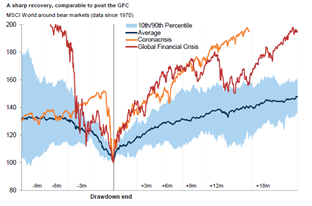
The picture below shows the development since March last year compared with the corresponding time intervals in the financial crisis in 2009 and onwards. Both periods have shown an unusually strong recovery and the current trend is even stronger than when the financial crisis raged 12 years ago.
Source: Goldman Sachs
Since the crisis started 1.5 years ago, we have had three different phases. The first and shortest, "despair", showed a decline in prices of 33 percent. The second phase, "hope", ended at the beginning of this year and showed a very strong return of 79 percent despite declining earnings. The last, “growth”, where we are now, has shown +11 percent in share prices with sharply rising growth for companies' earnings, but at lower valuations.

Source: Goldman Sachs
The recovery for American companies (below) has been extremely strong and compared to 2019, the 2021 profits will be approximately 36 percent higher. Very impressive.

Source: Goldman Sachs
It is very gratifying that Europe, for once, is keeping up with the United States and showing strong profit growth. Compare this with the non-existent profit growth between 2007–2019 (!)

Despite rising equity prices, valuations have fallen and Europe is now trading around 16x the profit 12 months ahead. It's not very strenuous (we think). For an average commercial property, you can get a return of maybe 3 percent before net financial costs. After financing, this corresponds to at least P/E 50x. And paying to lend to different countries does not feel like an exciting alternative either.

Source: Goldman Sachs
The valuation of global shares in relation to global GDP looks more strained. A major reason for this is the central banks' aggressive policy.

The valuation of the major leading technology companies is at an average level seen from the last five years.

Source: Goldman Sachs
The image below is striking. It shows that Swedish property prices, which have risen by almost 200 percent over the past 15 years, have had the same development as the money supply. In theory, price per m2 and krona is unchanged for the past 15 years. Is there anyone who still doubts that the world's central banks are responsible for the largest wealth creation in human history? It is important to be on the wagon because when it is gone you’ve missed it. And what central banks cannot push, the price of bitcoin for example, rises even more as central banks cannot make more of it. The opportunities for central banks to reverse the band are few. In the long run, this means that the next 10 years will, overall, be a good period for, for example, stock picking. All forms of uniqueness (growth) will be highly valued to compensate for the fact that the value of money decreases at a rapid pace.

If there is anyone who is still not convinced, take a look at the picture below. The market capitalization of the S&P500 divided by the Fed's balance sheet….

Source: Bloomberg
Onwards and upwards. The wealth of American households is accelerating away from the change in GDP.

Thank you Fed and all the world central banks!

Citigroup's surprise index has weighed down and analysts' profit estimates are also starting to soften. Not a good combination and it has undoubtedly contributed to the weak development in the stock markets recently.

It took a full 219 days for the S&P500 to have a decline of 5 percent. We will see how high the next bar will be.

Timing is everything. A fascinating graph that shows the importance of having reasonable timing in decisions.

Source: Goldman Sachs
Despite a difficult month behind us, it feels reasonable to expect a stronger market during the last quarter of the year. Our view is that we are still in a rising market, although we are likely to experience some turbulence for a few more weeks. "Bear markets" are constantly declining with sharp rallies while "bull markets" continue to rise with some strong drawdowns. We therefore believe that we are still in a rising market.
Some statistics to cheer you up. The S&P500 managed to rise by 0.2 percent in the third quarter (Europe -1.9 percent) which means six consecutive positive quarters. This has only happened eight times before and only on one of the (eight) occasions has the following quarter yielded a negative return. Two quarters later, it has in all cases yielded a positive return. In addition, for the past 20 years, October has been the fourth best month, thus much better than its reputation. Having pointed that out, October takes first place in terms of most frequent daily movements that exceed one percent.
The Stockholm Stock Exchange, which is an excellent reference point, had risen by 30 percent at its highest about a month ago, but is currently at 20 percent. Even more important is that measured in USD, OMX has "only" risen by 13 percent, which is in line with the US stock markets. This is hardly excessive given the profit growth among the companies. The risk premium in the market is high.
Investors are reasonably careless, and we are approaching the turn of the year. Global growth is well above average and interest rates are extremely low. Given how cruel the market has been to many investors this year, with sector rotations and a high concentration of companies driving performance, it almost feels obvious that the broad mass of investors will continue to reduce risk in their portfolios and then be short equities at year-end when the market rises. We'll see, but that's our main scenario right now.

We are now closing the books for the third quarter, and we look forward to the end of the year and above all the entrance for Truecaller on the Stockholm Stock Exchange on October 8!
Thank you for this month and we'll hear from you later.
Mikael & Team
Malmö on 5 October
[/et_pb_text][et_pb_text admin_label="Coeli Nordic Corporate Bond Fund R-SEK" _builder_version="3.0.89" background_layout="light" module_class="gen-table-module" disabled_on="on|on|on" disabled="on"]
Coeli Nordic Corporate Bond Fund
| Performance in Share Class Currency | 1 Mth | YTD | 3 yrs | Since incep |
| Coeli Nordic Corporate Bond Fund - R SEK | 1.30% | -0.93% | 3.38% | 14.52% |
| | | | |
[/et_pb_text][et_pb_text admin_label="Coeli Nordic Corporate Bond Fund R-SEK" _builder_version="3.0.89" background_layout="light" module_class="gen-table-module" disabled_on="on|on|on" disabled="on"]
[cg_linear_graph id="31122"]
[/et_pb_text][et_pb_image _builder_version="3.0.89" src="https://coeli.com/wp-content/uploads//2020/10/ncbr.png" show_in_lightbox="off" url_new_window="off" use_overlay="off" always_center_on_mobile="on" force_fullwidth="off" show_bottom_space="on" disabled_on="on|on|on" disabled="on" /][/et_pb_column][et_pb_column type="1_3"][et_pb_image _builder_version="3.0.89" src="https://coeli.com/wp-content/uploads/2019/01/Gustav-Fransson6.jpg" show_in_lightbox="off" url_new_window="off" use_overlay="off" always_center_on_mobile="on" force_fullwidth="off" show_bottom_space="on" custom_margin="||21px|" disabled_on="on|on|on" disabled="on" /][et_pb_text admin_label="Namn och title" _builder_version="3.0.89" background_layout="light" module_class="gen-single-ingress-module" custom_margin="||40px|" disabled_on="on|on|on" disabled="on"]
Gustav Fransson
Portfolio Manager of Coeli Nordic Corporate Bond Fund
[/et_pb_text][et_pb_image _builder_version="3.0.89" src="https://coeli.com/wp-content/uploads/2018/10/Alexander-Larsson-Vahlman.jpg" show_in_lightbox="off" url_new_window="off" use_overlay="off" always_center_on_mobile="on" force_fullwidth="off" show_bottom_space="on" custom_margin="||21px|" disabled_on="on|on|on" disabled="on" /][et_pb_text admin_label="Namn och title" _builder_version="3.0.89" background_layout="light" module_class="gen-single-ingress-module" custom_margin="||40px|" disabled_on="on|on|on" disabled="on"]
Alexander Wahlman
Senior Analyst
[/et_pb_text][et_pb_text admin_label="Fund Overview" _builder_version="3.0.89" background_layout="light" custom_margin="||20px|" module_class="gen-trustee-single-table"]
Fund Overview
| Inception Date | 2017-12-20 |
| Investment management fee (share class I SEK) | 1.00% p.a + 20% Performance fee (OMRX T-Bill Index) |
| Performance Fee. Yes | 20% |
| Risk category | 5 of 7 |
[/et_pb_text][et_pb_text admin_label="Top Holdings (%)" _builder_version="3.0.89" background_layout="light" custom_margin="||20px|" module_class="gen-trustee-single-table" disabled_on="on|on|on" disabled="on"]
Top Holdings (%)
| LANSBK 1.25% 18-17.09.25 | 4.1% |
| NORDEA HYP 1.0% 19-17.09.25 | 4.1% |
| SWEDBK 1.0% 19-18.06.25 | 4.1% |
| WHITE MOUNT FRN 17-22.09.47 | 3.9% |
| B2 HOLDING FRN 19-28.05.24 | 2.9% |
[/et_pb_text][/et_pb_column][/et_pb_row][/et_pb_section][et_pb_section bb_built="1" fullwidth="off" specialty="off" _builder_version="3.0.89" module_class="gen-trustee-single-yield-section gen-pattern-section" custom_padding="0px|||"][et_pb_row _builder_version="3.0.89" custom_padding="||53px|"][et_pb_column type="4_4"][et_pb_text admin_label="VIKTIG INFORMATION" _builder_version="3.0.89" background_layout="light" module_class="gen-trustee-single-warning-blurb"]
IMPORTANT INFORMATION. This is a marketing communication.
Before making any final investment decisions, please refer to the prospectus of Coeli SICAV II, its Annual Report, and the KIID of the relevant Sub-Fund. Relevant information documents are available in English at coeli.com. A summary of investor rights will be available at https://coeli.com/regulatory-information-coeli-asset-management-ab/.
Past performance is not a guarantee of future returns. The price of the investment may go up or down and an investor may not get back the amount originally invested.
[/et_pb_text][/et_pb_column][/et_pb_row][/et_pb_section]